
The Crucial First 24 Hours After a Chemical Spill
Why You Need an Emergency Spill Response Plan for a Chemical Spill
A chemical spill at an industrial facility can escalate quickly. What begins as a localized release can spread through floor drains, ventilation systems, equipment, soil, or other pathways, increasing the potential for employee exposure, environmental contamination, equipment damage, and operational disruption. The first 24 hours are particularly important for industrial post-spill site stabilization because early decisions can determine how contained the incident remains and how complicated the eventual cleanup becomes.
A structured response focuses first on protecting people, controlling the release, assessing the hazards, and bringing in qualified professionals when the situation exceeds the facility’s capabilities. EnviroBEE provides 24/7 emergency spill response and remediation for industrial facilities throughout the Carolinas and Virginia.
The First Priority: Protect People
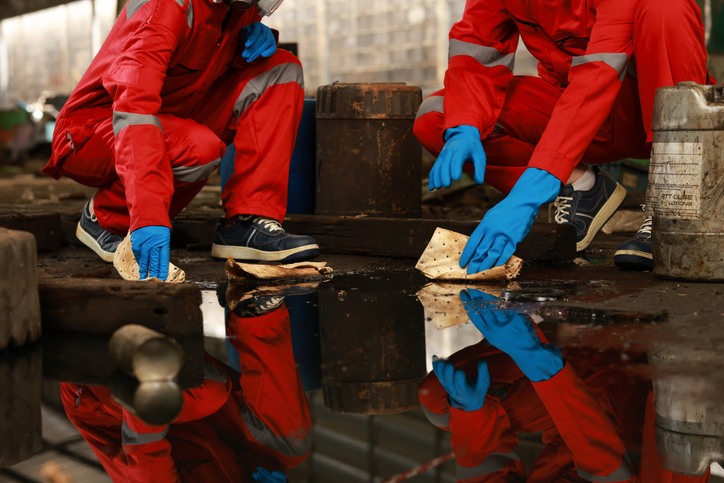
Immediately following a chemical spill, employee safety comes before cleanup. Personnel should follow the facility’s emergency response plan, alert others in the affected area, and evacuate or isolate the area as appropriate. Unauthorized employees should not enter a contaminated zone simply to investigate the release or begin cleanup.
Identifying Chemical & Its Risks
The identity of the chemical is an important part of determining the appropriate response. If it can be done safely, facility personnel should consult the container label or Safety Data Sheet (SDS) to understand potential hazards. Unknown substances should be treated cautiously rather than handled based on assumptions.
Some chemicals can release harmful vapors, react with water or other substances, or create hazards that are not immediately visible. Responders need to understand these risks before attempting containment or cleanup.
Containing the Spill & Preventing Spread
Once people are protected and the immediate hazard has been assessed, the next objective is containment. The longer a chemical remains uncontrolled, the greater the opportunity for it to migrate beyond the original release point.
Liquids can travel across floors, seep into porous surfaces, enter drains, or move with foot traffic. Vapors can spread through ventilation systems and potentially affect areas that were never directly exposed. A spill near a storm drain or floor drain deserves particular attention because drainage systems can provide a pathway to other parts of a facility or the environment.
Using Emergency Controls & Equipment
If the source can be stopped without placing personnel in danger, trained employees may follow established emergency procedures to shut off a valve, secure a container, or otherwise stop the release. Appropriate spill-control equipment can then be used to establish containment. It’s recommended that you have essential spill response supplies available, including absorbents, containment tools, drain covers, and properly labeled collection containers. However, facility personnel should not attempt actions that exceed their training, protective equipment, or emergency plan. Containment is important, but exposing employees to a hazardous chemical is not an acceptable tradeoff.
Assessing the Spill & Its Impact
A thorough emergency response incident assessment helps determine what happens next. Responders need to understand what was released, approximately how much escaped, where it traveled, and whether it has affected people, equipment, drains, soil, or other areas. The assessment should also consider less obvious pathways. A spill may appear contained on the surface while liquid has already entered a drain or contaminated cracks, joints, or porous materials. Vapors may also have migrated through an air-handling system.
Using Early Information for Response Planning
Early information is valuable for establishing the scope of the incident and determining the appropriate cleanup strategy. Depending on the substance and circumstances, qualified environmental professionals may need to perform monitoring, sampling, or additional characterization before environmental spill remediation proceeds. Early documentation can also provide an important record of site conditions and response actions.
Situations That Require Emergency Response
Not every chemical spill is appropriate for an in-house cleanup. Facilities should have clear criteria for determining when an incident requires outside assistance. Professional emergency response may be appropriate when:
- The chemical is unknown or particularly hazardous.
- The release is large or continuing.
- Vapors have spread beyond the immediate area.
- The material has entered a drain, waterway, soil, or ventilation system.
- Employees may have been exposed.
- Specialized protective equipment or containment equipment is required.
- The spill involves a confined space.
- Contaminated equipment, structures, or industrial materials require specialized cleaning.
Recording & Documenting the Incident
Documentation should begin as soon as practical without interfering with emergency response. Record the time the spill was discovered, the material involved if known, the estimated quantity, the location, the apparent source, the areas affected, and the actions taken. Photographs, monitoring information, sampling data, and other records may also help establish the scope and progression of the incident. Documentation can support internal investigations, regulatory reporting, insurance requirements, and decisions about subsequent remediation.
Meeting Reporting Requirements
Facilities should also follow their established notification procedures. Depending on the material, quantity, location, and circumstances, certain releases may trigger reporting obligations to regulatory agencies or emergency authorities. Businesses should know these requirements before an incident occurs rather than trying to determine them during a crisis.
Handling Contaminated Materials Safely
Chemical spill cleanup often produces more than the original spilled material. Absorbents, protective equipment, contaminated soil, damaged containers, sludge, liquids, and other materials may require further management.
These materials should not automatically be treated as ordinary waste. They need to be evaluated so the facility understands how they should be contained, labeled, transported, and managed. Improper waste characterization can create additional safety and compliance problems. Professional responders can help coordinate this part of the process.
Approaching Cleanup Correctly
Once the release has been controlled and hazards have been evaluated, cleanup can move forward according to the characteristics of the chemical and the affected surfaces. There is no universal chemical spill cleanup method. Using water, cleaning agents, pressure washing, or other techniques without understanding chemical compatibility can potentially spread contamination or create a reaction. Specialized industrial cleaning may be necessary when chemicals have affected equipment, tanks, drains, production areas, or other difficult-to-access locations.
Rely on EnviroBEE for Emergency Response
A chemical spill demands a fast, organized response, but speed should never come at the expense of safety. EnviroBEE provides 24/7 emergency spill response and remediation for commercial and industrial facilities, including industrial chemical spill cleanup, hazardous material response, containment, waste removal, and related environmental services. Our team can respond to both small and large-scale incidents and help coordinate the cleanup and management of affected materials. When your facility experiences a chemical spill, contact EnviroBEE for professional emergency response assistance and take the first step toward safely restoring your operations.